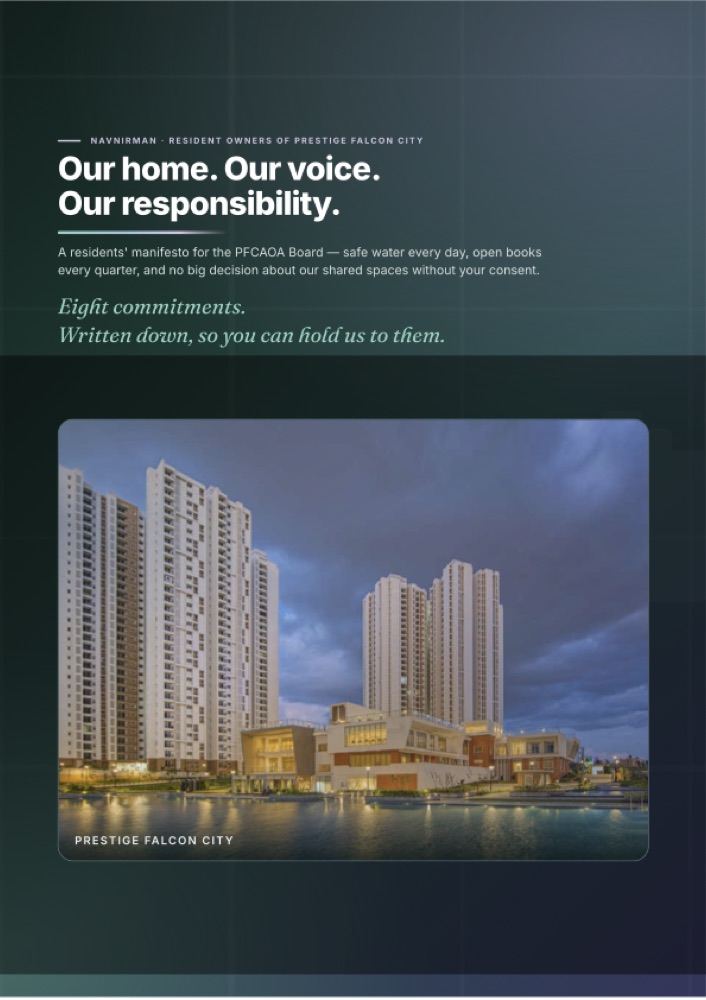
Eight commitments. Written down, so you can hold us to them.
Built on the registered PFCAOA bye-laws, so every commitment here is something the Board can actually do. Each one is written to be judged. Where a commitment says at regular intervals, that is deliberate: the detailed policy and standard operating procedure behind it — who does what, to which standard, and on which date — will be drafted, published and put to residents. We will commit to dates when we can commit to keeping them.
01
Safe water, every day
A full water audit — every borewell, sump, tank and pump, with 24 months of tanker spend alongside. NABL-accredited testing at source, after treatment and at taps across all five buildings, published good or bad. The treatment plant’s service log, and the STP’s results against its KSPCB consent limits, both published. Borewell yield and water levels published. No tanker discharges without a current lab certificate. A costed Cauvery Stage V plan put to your vote.
02
Open books, every quarter
A one-page dashboard every quarter: collections against budget, spend by head, arrears ageing, reserves and open complaints — same format each time. Every contract above ₹5 lakh a year in a public register; anything above ₹25 lakh by open tender with three bids and the comparison published. Security, facility management, tanker and STP contracts re-tendered.
03
Your vote before big decisions
The bye-laws already cap Board spending at ₹5 lakh a year outside the approved budget. We will enforce that, and add a General Body rule: any project above ₹50 lakh, any new structure on common land, any change of use of an amenity or any special levy needs a written proposal 21 days ahead, a town hall and a residents' vote, with the result published.
04
Shared spaces, shared decisions
Every proposal for a shared space goes through the same route — 21 days' notice, a town hall, a residents' vote. A published calendar of celebrations across communities, by rotation, with a small published budget. A complete file of sanctioned plans and approvals kept in the office and open to any member, so the next Board starts from facts rather than memory.
05
Fair finances
A forensic audit of three years of accounts and vendor contracts, by a firm chosen on open tender, with our cost per square foot benchmarked against five comparable townships — both published in full. A maintenance rate you can check, revised only at the AGM and never by circular. Every owner in arrears offered a written payment plan and mediation before any notice.
06
Health and safety first
A written trigger: five similar cases in seven days. Residents told immediately, the health office and BWSSB notified, independent sampling of every source, and updates at regular intervals until it closes. A 24x7 helpline with an ambulance on standby and a published target of under ten minutes to any tower, AEDs at the clubhouse and main gate, and two trained first-responders per tower.
07
A greener, future-ready PFC
Motion-sensor LED lighting piloted in two towers, measured savings published, then rolled out funded from the savings. EV-ready basements: a BESCOM load study, metered pay-per-use bays built to fire norms, delivered in published phases. A plastic-free campus with refill stations, per-tower water use published at regular intervals, and a mini pet park sited and designed by residents' vote.
08
Everyday living
Targets, not intentions: peak gate entry under three minutes, 99% lift uptime with a 30-minute rescue, 90% waste segregation at source, and 80% of noise complaints closed inside the service window we publish. A community-dog policy written with pet-owners and worried residents together. A café put to feasibility and a vote. A tenant welcome kit.
Water, in detail
The one thing here that reaches every flat every day, and the
one where a failure gets measured in hospital visits rather than complaints.
Where it comes from
Cauvery, borewells and tankers each carry a different risk, and we rarely know
which one we are drinking. The share drawn from each source published, with
what each costs. No tanker discharges into a sump without a current lab
certificate. A costed Cauvery Stage V connection put to a residents’
vote, set against what tankers cost us.
The treatment plant
A plant is only as good as its last service. Its operating log published:
filter media age and replacement, backwash frequency, dosing records, and the
outlet reading against the inlet. Third-party inspection of the plant itself,
not only the water it produces. Media, membranes and UV lamps replaced on the
manufacturer’s schedule, not when something tastes wrong.
What goes back
An under-performing STP is not just an odour complaint. Its output returns to
our own landscaping and our own flush lines. Outlet results published against
the KSPCB consent limits, running hours against design capacity, and how much
treated water is genuinely reused rather than discharged. Sludge handling
documented. Any bypass told to residents, not discovered at an AGM.
Testing at more than one point
Testing the inlet tells you what arrived, not what you drank. NABL-accredited
testing at three points — source, post-treatment, and a rotating sample of
taps across all five buildings, so no tower is assumed to be the same as its
neighbour. Results published in one format, good or bad, and kept online so a
trend is visible rather than a single reading.
The ground beneath us
Borewells are a shared and finite asset. Yield and static water level published
for every one of them, so depletion appears as a line on a chart instead of a
surprise. Ground water tested for what matters here — hardness, TDS,
nitrates and total coliform — not the cheapest available panel. Recharge
pits and rainwater harvesting structures inspected, with the report
published.
The audit, done properly
Every borewell, sump, overhead tank and pump mapped, with 24 months of tanker
spend alongside. Where the losses are, what is leaking, and what it costs. Done
thoroughly, so that every number published after it means something.
When summer comes
In March 2024 the supply was rationed to two windows a day and families were
asked to help fund tankers. Summer is not an emergency; it arrives every year.
A written summer plan — projected demand set against storage and borewell
yield, the tanker rate agreed before the season rather than in the middle of
it, and the rationing trigger published in advance, so nobody learns the rules
on the day they are applied.
Seven years in
Pumps, valves, pipework and tanks were installed together and reach the end of
their first service life together. They will not wait for a convenient year. A
condition survey of the water assets with remaining life and replacement cost
against each, so the reserve is planned rather than discovered — and so a
failed main is a scheduled cost instead of a special levy.
The record in full, all seven pillars with their goals, and the scorecard we
will publish every quarter. Everything on this page, in the detail behind it.
We are not promising to run the society. We are promising to hand it back to you.
A slate that cannot be removed is not accountable, and a promise with no date
attached cannot be checked. Both of those are in our own hands, so we are putting them in yours.
A scorecard at regular intervalsMeasured against the dates already published, not against a new set of promises
written after the fact.
An open house, in personThe scorecard read out in front of you, with the misses named first.
A removal clause we are not hidingThe bye-laws let residents remove any Board member by simple majority. We are
pointing at it ourselves, because a group that only mentions it when cornered
has told you something about itself.
Nothing here is a slogan. Every commitment is specific enough to check, published
in our manifesto — and we built it on the powers the association already has and has
not been using.